Contents
- Baby P
- Prosecution Opening Statement
- Defence Opening Statement
- Defence Closing Speech
- Agreed Facts
- Recorded Events and Messages/Facebook
- NEW: Lucy Letby in the Witness Box
- Direct Examination
- Cross-Examination
- Witness Statements Agreed
- Family - Mother (Babies O & P)
- Family - Grandmother (Babies O & P)
- Family - Father (Babies O & P)
- Witness Evidence
- Dr A [Thirlwall: Dr U]
- Dr Anthony Ukoh
- Senior Nurse Kathryn Percival-Calderbank
- Dr John Gibbs
- Dr Oliver Rackham
- Dr B [Thirlwall: Dr V]
- Dr Stephen Brearey
- Medical Experts Evidence
- Dr Dewi Evans
- Professor Owen Arthurs (Babies O & P)
- Dr Sandie Bohin
- Dr Andreas Marnerides (Babies O & P)
- NEW: Thirlwall Inquiry Evidence
Main Page
Baby P
Count 21: Murder of Baby P on 24 June 2016. Alleged mechanism: Air in NG tube
Dr Shoo Lee's International Panel Summary Conclusions
BABY 16 SUMMARY [Baby P]
Baby 16 is a 33+2/7 weeks, 2.066 kg birth weight, triplet 1, male infant born by caesarean
section for maternal discomfort. Infant had mild respiratory distress and was put on
continuous positive airway pressure (CPAP). At 16 hours of age, CPAP was changed to nasal
cannula, but 3½ hours later he developed apnoea. Abdomen was full and mildly distended,
soft with no tenderness and active bowel sounds, but with mild erythema at the base of the
umbilicus. Antibiotics were started. The next day, he suddenly developed desaturation and
low heart rate, and was intubated and ventilated with high pressures 26/6 rate, 60/min, FiO2
26% and given adrenaline. Chest x’ray showed a moderately large right pneumothorax. An
hour later, he again developed desaturation and low heart rate. Capnography showed the
endotracheal tube was dislodged. He was resuscitated, and a new endotracheal tube was
inserted. The pneumothorax was needled about 3 hours after the first deterioration, and a
chest tube was inserted another 2½ hours later. He had persistent metabolic acidosis despite
bicarbonate infusion. One and half hours later, he had cardiorespiratory arrest and died.
CONVICTION
It was alleged that air was injected into Baby 16’s stomach by nasogastric tube, which caused
gastric distension and splinting of the diaphragm, leading to collapse. The allegation has since
been changed to air was later injected into his intravenous line to cause air embolism,
collapse and death.
PANEL OPINION
The initial gaseous distension of the abdomen was caused by CPAP, and not by injection of
air into the nasogastric tube. It is unclear whether the nasogastric tube was open to drainage.
Baby 16’s care after the collapse on 24 June was mismanaged and there were unacceptable
delays in recognition and treatment of the pneumothorax. Delay in treatment of the
pneumothorax led to persistent metabolic acidosis because of persistent poor circulation and
gas exchange caused by the pneumothorax. It is unclear whether the pneumothorax
preceded or followed the resuscitation. Pneumothorax can occur in preterm infants with mild
respiratory distress syndrome, especially with CPAP or other respiratory support, or even
without any lung disease or respiratory support. The medical records do not show that a cold
light test was performed. He was treated with high pressure ventilation and adrenaline
despite having no lung disease and requiring only 26% oxygen. Both are harmful because
high ventilation pressures impede venous return to the heart, resulting in worsening
circulatory failure, and adrenaline punishes the heart by overworking it unnecessarily. There
were no signs of air embolism at final collapse.
CONCLUSIONS
1. Baby 16 died from pneumothorax that was suboptimally managed
2. There was no evidence of air injection into the stomach or into the intravenous line.
Prosecution Opening Statement
BackgroundThe prosecution allege Child P was murdered the following day from brother Child O.
Incident
Letby was the designated nurse for Child P.
Letby fed Child P donor expressed breast milk at 8am, 10am, noon, 2pm and 6pm.
The final feed, if accurately recorded, was about 13 minutes after Child O had died.
A feeding chart is presented to the court.
All the feeds from 8am-4pm are signed by a student nurse and co-signed by Letby.
The 6pm feed is signed only by Letby.
The court hears on the day shift feeds there is nothing more than a 'trace' aspirate (checking if there is anything in the stomach before the baby is fed), apart from a small amount of vomit at noon. The 8pm feed - the first after Letby's shift, produced a 14ml milk acidic (pH3) aspirate.
The court hears because Child O had died in unusual circumstances, Child P was reviewed by Dr Gibbs at 6pm. The abdomen was “full … mildly distended”. There was no tenderness and he had active bowel sounds – good signs.
He was screened for infection.
An x-ray taken at 8pm showed striking gaseous distension throughout the stomach and whole bowel.
Lucy Letby made her nursing notes at 8.24pm - therefore she was still in the neonatal at this time, Mr Johnson tells the court.
The allegation is Letby "deliberately caused the problems" as she was ending her day shift, so she would not be detected, Mr Johnson tells the court.
On that night shift, milk feeds were stopped for Child P on the grounds that a further large part-digested aspirate was drawn up the NGT at feeding time.
At 6.39am, a nurse recorded the abdomen was "soft and non distended."
25ml of air had been aspirated by one of the nurses, and the NGT had been placed on "free drainage".
Mr Johnson said the "problem" Child P had when Letby handed over to the night shift had been resolved. The problem appeared to be air.
When the next day shift happened, Letby was Child P's designated nurse again.
He was with his other brother - the third of the triplets - in room 2.
The court hears as events unfolded, while Letby was the designated nurse for the other triplet, care was transferred to another nurse.
Text messages Letby sent to a doctor at just after 8.30am suggest she had sent, or was sending, her student with a baby who needed an MRI scan.
A registrar noted Child P, at 9.35am, had “desat + bradys” and had a moderately distended / bloated abdomen and slightly mottled skin.
Letby's nursing notes from that night (9.18pm-10pm) recorded: "Written in retrospect...NG tube on free drainage - trace amount in tube. Abdomen full – loops visible, soft to touch … Reg...arrived to carry out ward round – [Child P] had apnoea, brady, desat with mottled appearance requiring facial oxygen and neopuff for approx. 1 min. Abdomen becoming distended. Decision made to carry out bloods and gas (approx. 09:30)”
The prosecution says it follows the problem with which Child P had been handed over by Letby to the night shift, but then apparently reappeared within 90 minutes of Letby taking over again.
15 minutes later, Child P had an acute deterioration. A crash call went out. Child P was intubated and improved, and efforts were made to transfer him to Arrowe Park Hospital
Child P desaturated again at 11.30am. He was given adrenaline.
His spontaneous circulation improved but he continued to deteriorate through the day.
A punctured lung was identified from an x-ray taken at 11.57am, treatment started at 12.40pm.
The transport team arrived at 3pm. Just before they arrived, Child P's blood gases were taken and were satisfactory.
A doctor was hopeful of Chils P's prospects.
The court hears Letby said to her something like:"he’s not leaving here alive is he?"
Child P's final collapse came at 3.14pm and, despite resuscitative efforts, he died at 4pm.
A post-mortem examination had the coroner concluding Child P died from Sudden Unexpected Postnatal Collapse but he was unable to identify the underlying cause. He certified the cause of death as “prematurity”.
Defence Opening Statement
For Child P, the defence agree the collapse could have occurred by a splintered diaphragm, but do not agree with how it was caused.The defence say Optiflow is a cause.
The defence agree once Child P collapsed, it was unclear why he did not respond to resuscitation, but that did not point to deliberate harm.
Defence Closing Speech
Mr Myers now turns to Child O's triplet brother, Child P. At 09:35 BST on 24 June 2016, a registrar found he was "self-ventilating in air" and stable, but 15 minutes later, he collapsed and required breathing support. He collapsed several more times, before being pronounced dead at 16:00. A medical expert for the prosecution said the collapses were consistent with an "additional amount of air being given to this baby"
Mr Myers says this case is another example of the Crown trying to 'shunt blame Ms Letby's way', he says the management of Child P's care was 'poor'. He notes that the baby had a pneumothorax and a X-ray which would have shown this was delayed Mr Myers says Child P's 'death was in all likelihood a consequence of poor medical procedure' after his 09:40 collapse. He says this case is 'a prime opportunity to hide poor performance and bad outcomes' and blame Ms Letby
A registrar Dr Ukoh recorded that at 09:35 on 24 June that Child P was self-ventilating in air. 15 minutes later, he suffered an acute deterioration at 09:50 hrs. Mr Myers says the Crown's case is that at some point between 09:35 and 09:50 Ms Letby injected the child with air He says 'whatever has happened, there is no opportunity' for Ms Letby to do this and says given the cast of doctors and nurses in the room it is implausible in the extreme
Mr Myers is taking the jury back over medical notes for Child P from the early hours of 24 June. He says they show the 'direction of travel', he says he was nil by mouth at this time. The senior nurse on duty said the child's abdomen appeared distended at 04:00 Mr Myers is going over the evidence for Child P final and fatal collapse when medics were waiting on a transport team from Arrowe Park to take him. A doctor who cannot be named recalled Ms Letby saying 'he's not going to leave here alive is he' The doctor gave a vivid account of how she felt this was inappropriate and that Child P had just had a good gas was okay. But Mr Myers has said the clinical evidence shows Child P had an undiagnosed pneumothorax He also notes that the doctor had said by this stage she was aware of rumours about Ms Letby - but he said 'there’s not even a datix report, not in the notes, no complaint, no issue raised about' what Ms Letby is alleged to have said
Mr Myers says the evidence does show the child was unwell and the doctor, in charge of his care, 'felt out of her depth' - she said in evidence how she was counting down the minutes waiting for the transport team to take him Mr Myers says if Ms Letby did make the remark alleged it may have been out of 'social awkwardness' and does not prove murder He says the allegation here against Ms Letby is 'utterly implausible'. He also cites the fact a senior doctor was seen by the mother of Child P 'googling' how to insert a chest drain - he says that is 'indicative of the level of care at the Countess of Chester'
Agreed Facts
Recorded Events and Messages/Facebook
From Dan O'Donoghue on X
I'm back at Manchester Crown Court for the murder trial of nurse Lucy Letby. The jury will be continuing to hear evidence in relation to the death of a baby boy, referred to as Child P, in June 2016. Ms Letby is said to have administered a fatal dose of air to the boy. Child P's death came just 24hrs after the death of one of his identical triplet brothers, Child O. Ms Letby is also accused of injecting him with air. She denies all charges.
Police intelligence analyst Claire Hocknell is first in the witness box - she's continuing to take the court through sequencing evidence for Child P (a 700 tile timeline of that baby boy's collapses and subsequent death)
24th June 2016
On June 24, 2016 Child P suffered a number of profound desaturations
and at various points required CPR and adrenaline. The boy collapsed for the final time at
15:14 that day and was pronounced dead at 16:00
An hour after Child P's death, Ms Letby text a colleague to say 'Life is too sad', 'lost another and third going to women’s' Her colleague responded: 'Omfg!! what the hell is going on! Don’t know what to say…will have a big hug for you when I get there'
A nursing note, recorded by Ms Letby, following Child P's death stated: 'I have dressed (Child P) at (the parents) request and taken photos of (Child P) and (Child O) together. Support given to parents and extended family'
In a message to a doctor [Dr A], who cannot be named for legal reasons, later that night Ms Letby said the two boys - who were part of a set of triplets - looked 'beautiful' together, but added that it was 'beyond words how awful it is'
Chester Standard article 20-03-2023
NURSE Lucy Letby fainted at work after she and fellow medics could not revive a baby boy, her murder trial has heard.
Letby, 33, is accused of murdering the newborn triplet on a day shift at the Countess of Chester Hospital's neo-natal unit in June 2016.
She is alleged to have given a fatal dose of air to the youngster, Child P, and also one of his brothers, Child O, who died a day earlier.
Child P's condition deteriorated on June 24 as he required CPR on four separate occasions before he was pronounced dead at 4pm.
Letby received a needle prick to her finger during the final resuscitation attempt, jurors were told.
Routine blood checks were required at the hospital A&E department where Letby later fainted.
She was later offered a lift home by a concerned doctor [Dr A] who friends had previously teased her about flirting with him.
Facebook message exchanges between the pair were read out on Monday, March 20 at Manchester Crown Court, in the 21st week of the trial before a jury.
[Dr A], who cannot be identified for legal reasons, asked Letby: "Have you been seen yet?"
Letby replied: "Yes just got back. I made a fool of myself whilst there."
[Dr A], who was also involved in the resuscitation efforts, said: "I asked them to be quick for you. How did you make a fool of yourself?"
Letby responded: "They said someone had asked for me to been seen asap and they knew what had happened today.
"Everyone talking about it whilst I was there. I fainted."
[Dr A] asked: "Oh are you OK now?"
Letby replied: "Bit shaky but OK. Writing my notes. They were reluctant to let me go as on my own."
[Dr A] said: "You could have bleeped me. I'm almost a responsible adult!
"Do you need a lift home?"
After she was dropped off by [Dr A] at her home address, Letby messaged him: "Thank you for the lift and for talking to A&E."
[Dr A] said: "I can't have you walking back in the dark after a rubbish day, mini needlestick and an A&E faint."
He later asked: "What are u doing? I can't concentrate on anything."
Letby said: "Wanting to (cry emoji)."
[Dr A] said: "Did in car. Must have looked a right mess when I got in."
Letby replied: "I keep thinking of them (Child O and Child P) both in the cot together. So peaceful yet beyond words how awful it is.
"So sad. The family thanked me when I took (Child P) in dressed. And I know age doesn't make it any easier/harder but such a lot to go through at a young age."
[Dr A] said: "I don't know how it would be possible to get over losing a child, let alone 2."
Letby responded with a crying emoji and wrote: "Think my head may explode…"
25th June 2016
On June 25 – when Letby is accused of attempting to murder another baby, Child Q, during
the morning of a day shift – she messaged the same doctor: "Nice lunch break, Told by mum
about needlestick and got a huge lecture about not being careful enough, overworked, doing
too much etc."
[Dr A] replied: "That's not what you need. She'll be concerned that you're not looking after yourself. Huge lectures aren't fun are they?"
Letby said: "My parents worry massively about everything and anything, hate that I live alone etc. Didn't know whether to tell them or not but I thought I better had in case anything comes of it. Lectures are not fun."
[Dr A] responded: "It sounds hard for all of you. I'm sure 'letting go' of your child (probably the most precious thing in your life) is difficult, especially if you don't stay local or do a job renowned for bad conditions and potential risks. What did you tell mum?"
Letby said: "I know, I feel bad because I know it's really hard for them especially as I'm an only child and they mean well, just a little suffocating at times and constantly feel guilty.
"Told her I was fine, accidents happen, wasn't anyone's fault, just one of those things and bloods etc all precautionary."
Lucy Letby in the Witness Box
Direct Examination
Lucy Letby gave this evidence on 17th May 2023.The trial is resuming after a short break. Mr Myers is now turning to the case of Child P, who weighed 2,066g. Mr Myers says there was "mild abdominal distention", recorded in Child P's clinical notes at 6pm on June 23, with "milk and air aspirates" recorded overnight. At about 9.40am on June 24, Child P had desaturation, distended abdomen, mottling. At 12.28pm, there was a further desaturation and bradycardia. Around that time, a pneumothorax was identified on the chest x-ray. At 3.14pm Child P collapsed, and later died at 4pm. A shift rota for June 23 is reshown to the court. Letby was designated baby for Child O and P and one other baby in room 2. Letby says the focus was on Child O that afternoon, and does not recall anything significant for Child P at that time. Her nursing notes from June 23: '...nursed in an incubator, observations within normal range, continues with 2hourly feeds...minimal aspirates obtained. Abdomen appears full but soft and non-distended...difficulty obtained IV access - secured after numerous attempts...' Letby says there was nothing concerning regarding Child P at this time. A doctor's note that afternoon for Child P records: 'Abdomen full; mildly distended' Letby tells the court there was "nothing unusual" about that. An abdominal x-ray for Child P is taken at 8.09pm, after Letby had stopped giving care for Child P. Letby tells the court she had stopped at 2pm that day "officially", as her care was focused on Child O that afternoon, and care of Child P was handed over. The x-ray report included: '...Gas-filled bowel loops throughout the abdomen...' Letby says student nurse Rebecca Morgan was still involved in the care of Child P. An observation chart for Child P for June 23 is shown. Letby says she signed at 8am and co-signed at 10am, with the observations filled in by the student nurse, Rebecca Morgan. The court hears Rebecca Morgan signed and filled in observations for noon, 2pm, 4pm and 6pm. Sophie Ellis records observations from 8pm onwards. The feeding chart is shown for June 23. Letby says she has co-signed at 8am, 10am, noon, and 2pm and 4pm, while Rebecca Morgan has signed and completed the entries. Trace' aspirates are recorded for Child P throughout the day, other than a 'small vomit' at noon. Letby says "other nurses" and Rebecca Morgan were looking after Child P by 6pm. Letby says after the overnight shift, Sophie Ellis said she was "quite concerned" for Child P due to the abdomen exam and following the events for brother Child O, and Child P was placed nil by mouth as a precaution. Nursing notes by Sophie Ellis on June 23-24 included: 'observations have been within limits. Did have 1 desat into 80s and 1x brady into high 90s. Self corrected, no intervention required. Does at times have a low lying HR between high 90s and 110. SHO aware. Feeding...14ml part digested milk aspirate gained at 2000 feed. Nurse in charge informed...continued with feed. 0000 feed, 20ml part digested milk aspirate obtained. Abdo is full but soft... In an addendum: 'Abdo has been soft and non distended. 25ml of air aspirated...NGT placed on free drainage.' Letby says the 14ml aspirate at 2000 was "a change", following "trace aspirates". A 20ml aspirate was taken and discarded at midnight. Letby says that was a sign the baby "was not digesting the milk", and that was a "decline" in the baby's health.
Letby says she would have expected the stomach for Child P to be
empty at that point. Child P, from midnight onwards, was nil by mouth and was put on 10%
dextrose fluids. 25mls of air was aspirated from Child P at 4am. Letby: "That is a very
large volume of air.
Mr Myers: "Should it be there?"
Letby: "No." 5ml of air and 2ml of milk is aspirated at 7am. Letby tells the court
that is something you would not expect to find at that time for a baby nil by mouth, and
said there had been a "noticeable decline" in Child P's health. The day shift for June 24
is shown to the court. Student nurse Rebecca Morgan is on the rota. Letby is the
designated nurse for a baby in room 2. The other surviving triplet is also in room 2, with
designated nurse Christopher Booth. Letby said she was asked to continue looking after
Child P. Asked for her opinion on that by Mr Myers, Letby said: "I felt that was the right
thing to do, for the parents to have that continuity." Letby recalls, for the morning of
June 24: "I was conducting my safety checks...noticed [Child P's] abdomen was quite loopy
- you could see the stomach had changed, was raised. I spoke to the nurse in charge about
this and wait for the [doctors to review]."
"Very soon" after the doctors reviewed Child P, Child P had an apnoea "that needed
attention". Letby says herself, Dr [Anthony] Ukoh and Rebecca Morgan were in the room at
the time of the deterioration. "[Child P] was apnoeic...I went out to call for help."
Other doctors were in room 1 as part of their ward round and came to assist, the court
hears. Child P stayed in room 2 -
Letby: "at this point room 1 was busy and it was felt safer to keep him in room 2"
Letby's nursing note for June 24, written at 9.18pm and finished at 10pm, is shown to the court. It includes: '...[Child P] nursed in an incubator...abdomen full - loops visible, soft to touch. Reg Ukoh arrived to carry out ward round - '[Child P] had apnoea, brady, desat with mottled appearance requiring facial oxygen and Neopuff for approx. 1 min. Abdomen becoming distended' Shortly after acute deterioration...'. Letby says Child P was intubated and "seemed stable at this point". Child P had a further desaturation at 11.30am - he was given adrenaline and he was paralysed with a drug to aid ventilation.
Letby says there was no issue with a tube dislodging, or one recorded in the notes. She recorded a pneumothorax, which had been identified in Child P after the collapse. Asked, outside of the notes, to recall Child P the rest of June 24: "I just remember there being a general decline through the rest of the shift." Letby said she "gave a lot of medication" to Child P. She said, for her nursing note written at the end of the day, notes were written contemporaneously on a piece of paper. Letby does not recall a distinct change in colour for Child P that afternoon. "There was an increasing sense of anxiety [on the unit]...and a huge sense of relief when the transport team did arrive [from Arrowe Park, a tertiary centre]".
Five Countess staff were there throughout the day, and one of the doctors "frequently left the building to have a cigarette", which the court hears was something they would normally do. Child P's medical needs were "beyond our level of care", Letby said. She tells the court that "potentially", she may have said words to the effect of "he’s not leaving here alive is he?". Letby says she was present when Child P died. She says support was given afterwards to the family. She remembers dressing Child O and Child P. Asked about the atmosphere in the unit after the second triplet died, Letby says: "It was completely flat atmosphere - everybody was shocked, devastated. The whole unit was just flat, generally. It wasn't the usual positive atmosphere we would have normally. "I was really upset - two days in a row, to imagine what the patents had gone through, it was harrowing."
The family communication note for Child P, by Letby, is written retrospectively at 10pm. I have dressed [Child P] at their request and taken photos of [Child O and Child P] together. Support++ given to parents and extended family. Time spent on lavender suite as a family.' Letby says the note was written "so late" as she had gone to A&E herself for a needle-stick injury. One of the needles for Child P had pricked her finger, the court hears. Letby says there was a pathway she had to follow, and she had to take boosters and vaccinations. She said she was "unwell - I had fainted" - she said from the stress of the day, she hadn't eaten. "The enormity of the past two days had taken its toll."
Letby confirms she completed her notes after her A&E visit, for Child P. Letby says a doctor she had been messaging had offered her a lift home, having been aware she had gone to A&E, and would be otherwise walking home alone at night. The doctor gave her a lift, and Letby tells the court he then drove home.
The court is shown handover sheets for June 25, 2016, recovered from Letby's home by police in 2018. Various notes were written on the back of that, the court hears. Asked to explain why this, and ones for June 23-24, were found at her home: "They have come home in my uniform, and I have not done anything with them." The handover notes also include other babies Letby was the designated nurse for. A message from Letby to a doctor on June 23 said: "I lost my handover sheet - found it in the donor milk freezer!! (clearly i should still be in Ibiza)" Letby is asked to explain a search for the surname of Child O and Child P on June 23, 2017. Letby said the date was the anniversary: "they were on my mind. "It was such a harrowing experience seeing parents lose two of their children. "In two days running, you don't forget something like that." This note is shown to the court:
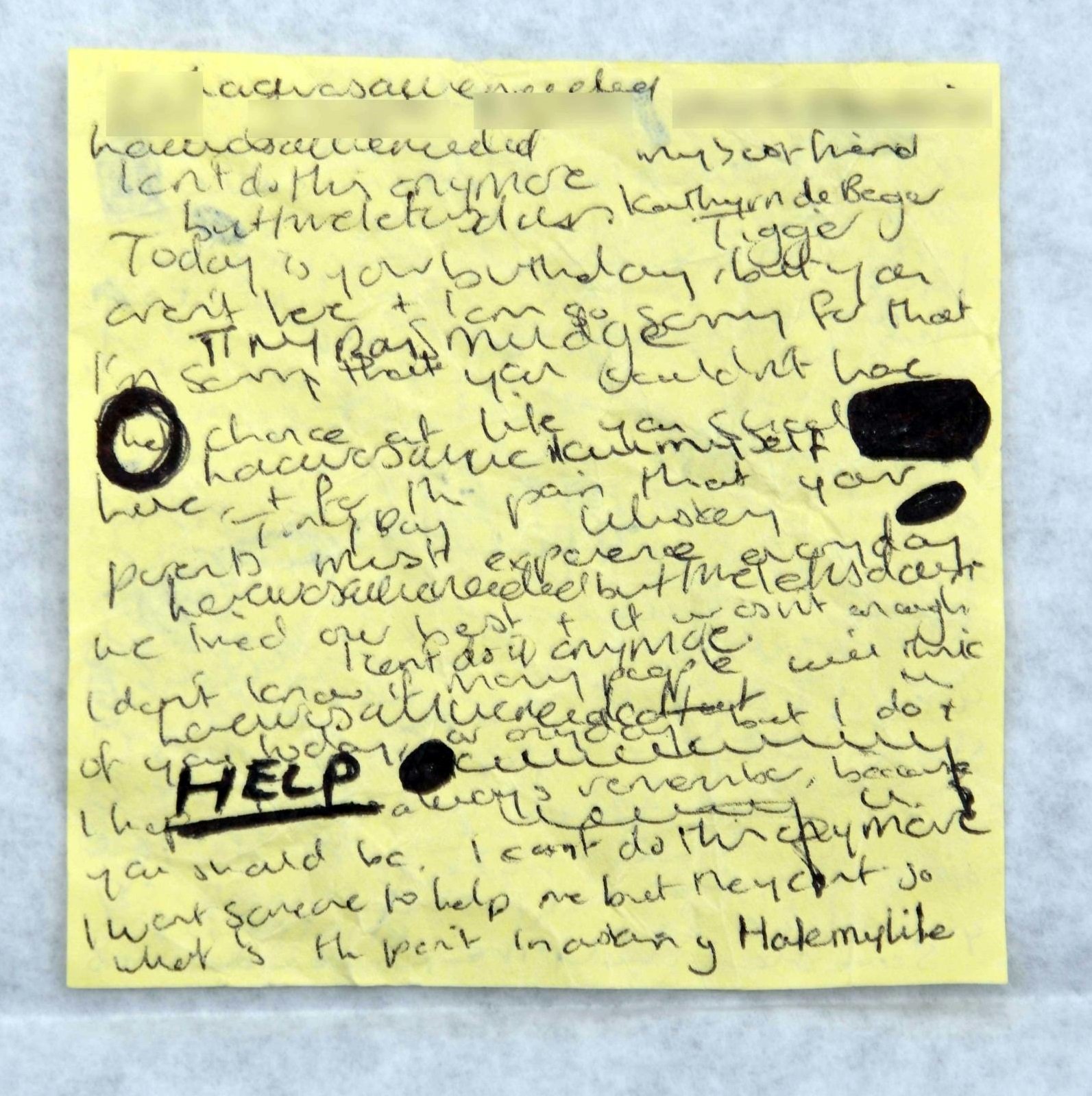
The note, the court hears, is a reference to the anniversary of Child O and Child P's death. Letby adds her writing also was how she felt at the time of writing the note.
Cross-Examination
Lucy Letby gave this evidence on 8th June 2023.Mr Johnson turns to the case of Child P, triplet brother of Child O. Letby, in her defence statement, denies hurting Child P. She said she did not recall having an argument with nursing colleague Kathryn Percival-Ward about working in room 1. She said she was in conversation with student nurse Rebecca Morgan when Child P collapsed. She said it was "chaotic" with all the staff arriving to resuscitate, and Child P was too poorly to be transferred to room 1, so was kept in room 2. Child P's stomach was 'red'. She says at some stage she pricked herself with a cannula needle and needed to go to A&E for treatment. While there, she said she fainted, she believed due to stress at the time of the past few days, and had not eaten. She said she had 'forgotten' she had taken a handover sheet home with her.
An examination of Child P at 10am on June 23, 2016 was "unremarkable", the court hears. Letby accepts that. She adds there was nothing of note during the day. Mr Johnson suggests Child P worsened after Child O passed away. Letby agrees. A 6pm feed for Child P is signed by Letby, and she says the writing above is not by her. Dr John Gibbs had reported in his 6pm review for Child P that the baby boy was doing well. A blood sample taken at 6.35pm taken to a lab showed no signs of infection. Letby denies overfeeding Child P 'at some point' between 5pm-8pm on June 23.
The trial is now resuming after its lunch break.
The cross-examination continues in the case of Child P. Letby agrees there were 'no problems' at the time of the handover for Child P on the night of June 23. She recalls the x-ray taken shortly after that handover. The x-ray report said: 'NG tube in satisfactory position...gas-filled bowel loops throughout the abdomen, through to the lower rectum, with no evidence of obstruction and no plain film signs of perforation' Letby denies pumping Child P with air. She agrees this was a deterioration for Child P. Medical expert witness Dr Owen Arthurs had previously told the court this image was "quite unusual" for a baby of that gestation. Letby says she cannot comment how the gas got there, only that she did not put it there.
A 14ml aspirate is recorded for Child P at the time of handover at
8pm.
NJ: "That was your doing, wasn't it?"
LL: "No."
NJ: "On your way home, you were sowing the seeds with your colleagues?" Mr Johnson
refers to the 'Worry as identical' text message Letby had sent. "You were feeding a false
narrative, trying to divert attention away from your homicidal activities?"
LL: "No."
5ml of air and 2ml of milk is aspirated from Child P at 7am. "How
much milk had [Child P] been fed overnight?" Letby said Child P had been fed prior to
midnight. She says if the NG Tube is in the stomach, air would come out. Letby disagrees
that Child P was well at the morning handover time, as Child P was 'nil by mouth'. A
police interview had earlier said Letby saying Child P was stable and well. Mr Johnson
suggests Letby is deliberately making the appearance of Child P worse now than at the time
she gave her police interview.
LL: "No."
The day shift for June 24 is shown to the court. Student nurse Rebecca Morgan is on the rota. Lucy Letby is the designated nurse for Child P in room 2. The other surviving triplet is also in room 2, with designated nurse Christopher Booth. Child Q is in room 1 with two other babies. Three babies are in room 3, and three babies are in room 4.
Letby rules out staffing levels as a contributory factor in Child P's collapse and death. She also rules out staffing mistakes. She says there were "some issues with the chest drain", but "cannot say" how much of an effect that had on Child P.
By 0639, Sophie Ellis’ nursing note recorded that “abdo has been soft and non distended. 25ml of air aspirated by SNP Kate Ward. NGT placed on free drainage”. Mr Johnson says Letby created a false nursing note at 8am to say: "...abdomen full - loops visible, soft to touch." He says that is not the picture from 6.39am. Letby agrees that is not the same as Sophie Ellis' note. Sophie Ellis's note for June 23 for Child O: 'Abdo looks full slightly loopy...abdo soft.' Letby says her observation for Child P that morning was what she saw. She informed a doctor an hour later about the abdomen observation. She denies a suggestion by Mr Johnson that she is lying.
Letby says she escalated the observation to the shift leader. Mr
Johnson asks if Letby knew what she was telling her friend, the doctor, at this point.
Letby does not recall. The message shown to the court, sent at 8.04am: 'I've got [child]
and [Child P], [Child P] has stopped feeds as large asps.' Mr Johnson asks why Letby is
lying about having the first child, whose designated nurse was Christopher Booth. Letby
says she would have to check the paperwork, as she may have been assisting. Letby's
follow-up message, at 8.19am: '...I'm ok, just don't want to be here really. Hoping I may
get the new admissions...' Mr Johnson asks why Letby didn't raise it with the doctor
colleague who was coming into work. Letby says the doctor was not present in the neonatal
unit that day. He went to the children's ward. Letby denies the observation was a
'fabrication' as Dr Anthony Ukoh saw loops as well. She said the context of 'don't want to
be here really' was what she had seen earlier with Child O. Mr Johnson refers to Dr Ukoh's
note of observation at 9.35am: 'Abdomen moderately distended/bloated; soft'. Mr Johnson
says there is no mention of loopy bowels.
Letby: "No." Letby says Dr Ukoh might not have recorded it.
NJ: "Or you have misrecorded it."
LL: "No."
Within a few minutes of Dr Ukoh reviewing Child P, Child P collapsed.
NJ: "That has to be your doing, doesn't it?"
LL: "No." Mr Johnson says Rebecca Morgan's evidence was Letby had left the room at the
time of collapse. Letby says from her recollection, she was in the room, and is "quite
clear" on that. Letby's note for the desaturation: '...[Child P] had an apnoea, brady,
desat with mottled appearance requiring facial oxygen and Neopuff for approx 1min. Abdomen
becoming distended.' Mr Johnson says the note is deliberately written to make it look like
the Neopuffing made the abdomen become more distended. Letby agrees.
Dr Ukoh, the court is told, gave evidence to say Child P was in a
very different condition between 9.35am and 9.40am. He also said Letby was "very keen" for
the doctor colleague to be called. Letby says this was because he had been present for
Child O's deterioration. She adds it was one of the other doctors who suggested getting
that doctor.
NJ: "Were you trying to attract [the doctor's] attention?"
LL: "No."
NJ: "Did you enjoy being in these crisis situations with [the doctor]?"
LL: "No....[doctor colleague] and I were friends.
NJ: "Something to share?"
LL: "No."
Child P desaturated again at 11.30am. He was given adrenaline and he
was paralysed with a drug to aid ventilation as he had been 'fighting the ventilator' with
his breathing. A note in Letby's handwriting is shown to the court. It details the efforts
to resuscitate Child P. It was found at her home. Letby accepts she had put it there.
LL: "I collect paper and that's where it ended up...I have difficulty with throwing
anything away, particularly paper.
NJ: "Is there anything comforting in keeping the paper?"
LL: "I keep paper yes, from a variety of different sources." Letby clarifies she does
not include bank statements in that. Letby was recorded by a nursing colleague as saying
for Child P: "He's not leaving here alive is he?" Letby disputes that. "I don't recall the
conversation."
Child P's final collapse happened at 3.14pm, just after doctors had
reviewed him. Letby says she cannot recall shouting for help, and cannot recall Child P's
breathing tube being dislodged.
NJ: "The problem happened just after everybody left, just after you had said 'He's not
leaving here alive is he?'"
LL: "I don't agree I said that.
NJ: "Is this another case of bad luck, that is happened just after everybody left?"
LL: "Yes."
NJ: "Did you enjoy making predictions when you knew what was going to happen?"
LL: "No."
NJ: "You were very excited in the aftermath of [Child P's] death?"
LL: "No, I was not." Mr Johnson says a female doctor colleague had said she acted 'in
a totally inappropriate way'
LL: "No I didn't." She adds that was what the female doctor colleague had said. Letby
says she told colleague Sophie Ellis "out of respect" what had happened. Mr Johnson said
Sophie Ellis had been to the races - "why not leave her alone?". Letby said Sophie Ellis
had texted her first.
Mr Johnson: "Did you enjoy the drama?"
LL: "No." Letby's response to
Sophie Ellis: 'Just blew tummy up and had apnoeas, downward spiral. Similar to [Child
O] x' Mr Johnson said the message were identical to the one for Child O. Letby said that
was what happened, his tummy blew up and he had apnoeas.
NJ: "Your portent of doom had fulfilled itself, hadn't it?"
LL: "No."
NJ: "At your hand."
LL: "No."
The trial is resuming after a short break. Mr Johnson clarifies from a text message sent to a doctor colleague, Letby did have two designated babies at the start of that shift, one of whom was Child P.
Witness Statements Agreed
Family - Mother
A statement from the mother of Child O, Child P and the other triplet is read out to the court. She says she had a 12-week scan at the Countess of Chester Hospital 'which seemed to take a bit longer than normal', where her partner realised there was more than one baby. It was confirmed she had triplets. The triplets would be identical, she was informed, and she was referred to Liverpool Women's Hospital to see a specialist. She was informed there was an 80% chance one of the triplets would be smaller than the other two.
Two weeks later she went for a follow-up scan, and everything was 'fine', as were further fortnightly scans. She was informed the triplets were 'unlikely' to stay at the Countess of Chester Hospital neonatal unit, as there would not be the space for three nursery beds, and they may have to be treated at Birmingham. On June 21, the mother was admitted to the Countess of Chester Hospital, was assessed, and advised to go for a C-section. She went to theatre at 2pm, and the triplet boys were born shortly afterwards. They had been named in advance, and the babies were named in the order they came out. In recovery, she was brought pictures with the boys and their birth weights recorded.
The mother was taken to see all the baby boys, and handled all of them. On the neonatal unit, there "didn't seem to be any routine for washing hands". All the triplets were in nursery room 1, and they were all brain scanned, with no concerns.
The following day, the mother was taken to see the triplets, and was informed all were doing well. She said she asked on numerous occasions, about expressing milk, but no-one came to help until after Child O passed away, when a nurse called Lucy handed her an information leaflet.
On June 23, the mother was in the ward and still struggling to walk.
About 10-15 minutes after the father had been to the unit, he came back with a consultant
doctor, who informed her Child O's stomach had swollen and 'needed a little help to breathe,
so a tube had been put down his throat'. He was calm and said this was normal. The mother
was put into a wheelchair, and upon arrival at the nursery, she said: "By the time I got
there, it was a scene of chaos". A lot of doctors and staff surrounded Child O. "I remember
nurse Lucy was there, all the time."
"The staff appeared to be in a state of panic, and it didn't seem controlled at all."
The mother said she sat outside, and could not bring herself to be too close, as Child O
kept arresting and changing colour. "He was swollen all over his body".
At some point, another doctor arrived and told the mother "things weren't looking good" for Child O, and said if he did survive, he would likely have brain damage. Child O passed away at 5pm. Child P and the other boy were in nursery room 2. The mother said: "This whole episode had come like a bolt out of the blue. On the face of it, everything seemed to be going well with the triplets. "As a family, we were naturally devastated. "With hindsight, there were a number of things we found unusual." The mother said she didn't expect a student nurse to be looking after one of the babies. She said they kept seeking reassurance that the other two boys were fine.
A doctor [Dr B], who was "quite upset", said she was very sorry for what had happened to Child O, and photos were taken of the baby boy. The mother said she didn't sleep at all that night. She, at one point, asked the midwife to check if the other two boys were ok. She was reassured they were fine. The following day, they went to the neonatal unit and were informed by a nurse the two boys had "been like angels", behaving all night and feeding regularly.
The mother recalled having breakfast and freshening up. She then heard voices and saw a midwife was present and advised to go to the neonatal unit, as Child P was unwell. "I was devastated. A couple of hours earlier he had been fine. "I called my mum to tell her it was happening again." When she arrived, she said it was "like deja vu" and the situation was "chaotic" with people "running around" in nursery room 2, where both boys were.
The mother said she sat outside "for long periods of time". At one point, a young doctor looked to be Googling 'how to insert a line'. They needed to do this process as Child P's lungs had collapsed during CPR. "This alarmed me". The mother was informed they were looking to transfer Child P to Liverpool, but they needed to stabilise the baby first as he kept collapsing. She was told things were "looking a lot more hopeful" for Child P - he looked veiny, but his stomach was not distended like Child O's was. At some point, the transport team arrived. The reaction from the transport team was "incredible to watch" as "they just took over". Even the consultant took a back seat'. "We were reassured, he seemed calm." Child P passed away. The mother said she and her partner "begged" the transport team to take the surviving boy with him to Liverpool Women's Hospital.
The mother said she had to discharge herself from the Countess of Chester Hospital, and asked for her care to be transferred to Liverpool. "They refused, which was the last thing I needed." The mother travelled to Liverpool, having stopped to pick up some clothes along the way, and were . "We were just made to feel at ease - the two hospitals felt like night and day." The staff said the surviving baby boy could be treated there for as long as there was a bed available, but did not need intensive treatment. The surviving baby stayed at the hospital for three and a half weeks. The mother said she was "surprised" there was not 1:1 nursing care for the triplets, and a student nurse was looking after them, with Lucy Letby 'popping in'. Lucy Letby was "extremely emotional" and "in pieces" after Child P passed away. She was "in floods of tears", the mother said. A doctor also arrived and "was also upset".
Family - Grandmother
A statement from the grandmother of the triplets is now being read out. She said she was aware the triplets were identical and couldn't be told apart, apart from their identity tags, and were in differently coloured blankets, and were all of good weight. "All was well, up until June 23." She was informed "something was wrong" with Child O. She left work and travelled to the hospital, and upon arrival, Child O was being baptised, and the parents were "hysterical" and "at a loss". The grandmother recalls Lucy Letby was there, and was "softly spoken". Child O continued to deteriorate, and a Dr John Gibbs was called to the unit, who asked Lucy Letby how many shots of adrenaline had been administered, and Lucy said she was not sure, three or four. Dr Gibbs replied: "Well, what was it, Three or four?" Lucy Letby appeared to be referring to a scrap of paper for records which had yet to be updated. Lucy Letby was in the unit, and the grandmother said: "I remember thanking her for her assistance during the ordeal." The grandmother said she could not recall what happened with Child O, as she was too busy consoling the parents. When she received the "awful call" about Child P being unwell, the grandmother was at home. She arrived at the hospital and saw a number of doctors surrounding Child P. There had been "a significant improvement" in Child P's condition. His condition 'seemed fine' for an hour or two, but then took a dramatic turn for the worse. Outside the nursery room, a nurse researched a procedure on a desktop computer. "I was a little surprised at this, as I assumed the staff knew what they were doing. I thought they were possibly just confirming the procedure." Child P continued deteriorating and the call was made to transfer him to Liverpool, but Child P sadly passed away. It was decided that as the transport team were already present, they would take the surviving boy to Liverpool Women's Hospital, as they were not sure if there was a congenital condition. A doctor informed the family there would be post-mortems for Child O and Child P to establish the causes of death.
Family - Father
A 15-minute video interview is now being played, as agreed evidence, with the father of the triplets. The video interview was recorded in December 2019. He says, for June 23, the scene was "a mess". He recalls being taken to the unit by a nurse 'asap', "there's something going on". He said he and the mother both "panicked". He recalls there was "definitely swelling" on Child O, but could not recall why, and, getting upset and pointing to his hands, he says there were 'bright blue' veins.
He said medical staff were doing 'not a lot', and seemed to be concentrating on Child O's temperature. He said there were "lots of people, rushing in and out". He recalls seeing a 'pot belly' appearance for Child O, which then had 'gone down'. The ordeal lasted "ages" for Child O. It "seemed like hours". The doctor could offer 'no explanation' for what had happened to Child O which has resulted in him dying, the father recalls.
The interview talks about the events of June 24. The father recalls having spent time with the two boys. He recalls the scene for Child P was "worse than the day before", and was "pandemonium". He said there was nothing of the sign for Child P of a swollen belly. He said the medical staff did not have any explanation for why Child P was unwell. The transport team arrived, but Child P passed away within 10-15 minutes. He recalls he and the mother asked the transport team to take the surviving baby boy to Liverpool Women's Hospital. The father adds: "I am sure it was Lucy Letby who wheeled the two boys to us. She said how sorry she was. "I'm pretty certain she dressed them up." He said it was Lucy Letby's job to do up the memory box, which included an SD card containing memories of Child O and Child P. The surviving baby stayed in Liverpool for 'about 11 days' and there were 'no complications at all' apart from a 'small hole in his heart', and remained stable.
Nurse Amy Davies
Court is currently being read agreed evidence. First statement is from Amy Davies, who was a neonatal practitioner in 2016, she recalls having no concerns about the triplets in the days after their birth in late June 2016
Witness Evidence
Dr A [Thirlwall: Dr U]
See also: Dr A/U's oral testimony at the Thirlwall Inquiry
[Dr A], who cannot be named for legal reasons, is now in the witness box. He cared for Child P in days after his birth on 21 June. He tells the court that he was born in good health, he was 'pink, well perfused and temperature acceptable'
We're back after a break for lunch. [Dr A] is continuing to give evidence. He's going over notes from 24 June, when Child P collapsed on a number of occasions
[Dr A] tells the court that on the afternoon of 24 June he fitted a chest drain for Child P as he was suffering a suspected pneumothorax
The court has just heard how Child P went into cardiac arrest at 15:14, [Dr A] recalls how chest compressions were commenced along with breathing support and four doses of adrenaline administered
After 45mins the decision was taken, in conjunction with his family, to stop resuscitation. Prosecutor Simon Driver asks the doctor: 'Can you understand the course his life took over those few days (since his birth)' 'No', the medic responds
Dr Anthony Ukoh
See also: INQ0106972 – Witness Statement of Dr Anthony Ukoh, dated 20/07/2024
Dr Anthony Ukoh, who also helped with Child P's treatment on 24 June, is now in the witness box
Dr Ukoh assisted with one of Child P's earlier collapses. He told the court that he examined the baby boy and was called back 20mins later as he his heart rate had 'plummeted'. Two other doctors were called to assist and Child P was eventually stabilised
Senior Nurse Kathryn Percival-Calderbank
See also: Kathryn Percival-Calderbank's oral testimony at the Thirlwall Inquiry
Chester Standard article 21-03-2023
On Tuesday, March 21, senior nurse Kathryn Percival-Calderbank told jurors that Letby was "unhappy" if she was allocated shifts in either room three or four.
She said: "She expressed that she was unhappy at being put in the outside nurseries.
"She said it was boring and she didn't want to feed babies. She wanted to be in the intensive care".
Mrs Percival-Calderbank, who qualified as a nurse in 1988, added: "If anything was going on within nursery one you would find she would migrate there, as we would all do to go and help. She would definitely end up in nursery one to assist.
"It was more that we were worried for Lucy's mental heath because it can be upsetting, emotional and sometimes exhausting as well at the end of a shift, if you're constantly put in that stressed situation all the time.
"Sometimes you've got to come out of that environment and be in an outside nursery."
She recalled an argument – some time before June 2016 – with Letby who was "upset" at a shift allocation.
"Lucy went into the outside nursery but she was not happy with the decision," she said.
'Particularly keen to assist'
Ben Myers KC, defending, asked the witness: "Is it right she made it plain that she preferred to work in the intensive care aspect of operations?"
"Yes," replied Mrs Percival-Calderbank.
Mr Myers said: "Did she use the word 'boring'?"
The witness said: "Yes, that's what she said."
Mr Myers said: "There were times when she ended back in nursery one and everyone would be ready to help when there was an issue, wouldn't they?"
"Yes," said the witness.
Mrs Percival-Calderbank agreed with Mr Myers that Letby would be "particularly keen to assist" and "would be there very quickly if an issue arose".
She also agreed the concern among nursing staff was it could be "very stressful and upsetting" to work long periods in intensive care and it was beneficial for mental well-being to spend time away from nursery one.
Mr Myers said: "But she didn't really want to hear that and she wanted to do the intensive care, is that right?"
"Yes," said the witness.
Dr John Gibbs
See also:
INQ0008978 - Pages 4 & 5 of letter from Dr John Gibbs to Mother & Father C re Child C's death, dated 24/09/2015
INQ0001993 – Page 14 of Witness statement of Dr John Michael Gibbs, for the trial of R v Letby, dated 20/11/2017
Dr John Gibbs' oral testimony at the Thirlwall Inquiry
Consultant Dr John Gibbs is first in the witness box. He is recalling the events immediately after Child O's (Child P's brother) death on June 23 2016
Dr Gibbs tells the court that when he saw Child O, in the moments before his death, he remembered 'feeling uncomfortable and thought oh no, not another one' … He said he had become 'increasingly concerned at the accumulating number of unusual, unexpected and inexplicable collapses that had been happening on the neonatal unit and that staff nurse Letby had been involved in all of them'
Dr Gibbs tells the court that after Child O's death, his brother Child P was started on antibiotics and sent for an abdominal X-ray as a precaution
Dr Gibbs said that Child P was a 'well baby' on 23 June. He said he was 'extremely concerned' to learn of Child P's death the following day, he said he 'would not have expected that at all'
Dr Gibbs tells the court that the death of the brothers was a 'tipping point for realising something very abnormal and wrong was happening on our neonatal unit'
Ben Myers KC puts it to the medic that if he had a genuine concern, he himself would have taken action - Dr Gibbs says he was aware his colleague Dr Stephen Brearey had raised concerns with nursing management and senior managers at the hospital
Mr Myers repeatedly put it to Dr Gibbs that if he had concerns he would have taken action. Dr Gibbs repeated that he knew it had been raised by colleagues with management. He said the senior consultants had openly discussed 'the one common factor' in the baby deaths
He said it was noted that Ms Lebty had been present on the unit or caring for the babies when they had collapsed in unusual circumstances. Mr Myers asks why it hadn't been reported to the police, Dr Gibbs said it was 'difficult' as they didn't have 'the full picture'
Eventually, Dr Gibbs said that consultants insisted that Ms Letby be removed from the unit. He tells the court that management pushed for her to return a month later - they said only if CCTV is installed in each unit He said the 'TV cameras never came and neither did nurse Letby'
Dr Gibbs said 'over the next 11months we had to resolutely resist attempts by management to have staff nurse Letby back on the unit'
Chester Standard article 22-03-2023 article 2
SENIOR doctors demanded the installation of CCTV cameras at a hospital unit if Lucy Letby was allowed to return to nursing duties, her murder trial has heard.
Concerns over an "accumulating number of inexplicable collapses" reached a "tipping point" with the deaths of two newborn triplets in June 2016, a consultant told Manchester Crown Court on Wednesday, March 22.
Dr John Gibbs told jurors that a number of "key safety measures" were then introduced including the removal of Letby from the neonatal unit.
However a month later he said hospital bosses wanted Letby – whom the consultants had identified as "the common link" to the collapses – back on the unit.
He told the court: "We said that should only happen if CCTV was put in each room in the unit.
"The CCTV didn't come and neither did staff nurse Letby."
Dr Gibbs, now retired, went on: "In the 11 months before the police got involved, after we raised concerns about the deaths of (Child O and Child P), senior management were extremely reluctant to involve the police to discuss what had happened because we had to keep insisting the police be involved."
Letby is accused of murdering seven babies and attempting to murder 10 others on the neonatal unit between June 2015 and June 2016.
She is said to have administered fatal doses of air to both Child O and P on successive day shifts.
Dr Gibbs reviewed Child P's condition shortly after the death of Child O on June 23.
He told the court: "'I remember feeling uncomfortable when I arrived on the unit and saw (Child O) and I thought 'Oh no, not another one'.
"I'd become increasingly concerned, and my consultant colleagues shared the concerns, at the accumulating number of unusual, unexpected and inexplicable collapses and deaths happening on the neonatal unit and the fact that staff nurse Letby had been involved in all of them.
"The deaths of the two triplets was a tipping point for realising something abnormal and wrong was happening on our unit."
Ben Myers KC, defending, said: "The reality is, as we stand here now, you are heavily influenced by a bias against nurse Letby that applies to all of you."
Dr Gibbs replied: "I was most heavily influenced by what was happening to babies on the unit… there was only one common factor."
Mr Myers asked: "You didn't contact the police, did you?"
Dr Gibbs said: "That was difficult. Nurse Letby seemed to be involved in all of the cases that involved me. Other consultants were involved with other babies.
"None of us regrettably realised two babies had been poisoned by insulin, so we didn't have the full picture.
"After the deaths of the triplets – very regrettably too late for them – because the concerns had reached a tipping point, safety measures were introduced and one of the key safety measures which the consultants were insistent on was Lucy Letby be removed from the neonatal unit and that was not a simple, straightforward decision."
Mr Myers said: "You took your time asking for CCTV if your suspicions were so great, Dr Gibbs?"
Dr Gibbs replied: "I said increasing concerns were growing over that time. The tipping point was the tragic deaths of the triplets which, looking back, should not have happened in healthy boys."
He said that Dr Stephen Brearey, the senior consultant in charge of the unit had previously flagged concerns to management in 2015 about the association with Letby and collapses of babies.
Dr Oliver Rackham
See also: Dr Oliver Rackham's oral testimony at the Thirlwall Inquiry
We're now back after a short break for lunch. Dr Oliver Rackham is now in the witness box. He was part of the transport team from Arrowe Park Hospital (he was overseeing the transport of Child P to the hospital before his death)
Dr Rackham was on the neonatal transport team responsible (called Connect) in June 2016. He remembers being given a briefing on 24 June about Child P (he had suffered a number of desats that morning)
The medic tells the court that soon after he arrived at the Countess of Chester, at around 3pm, to transport Child P he collapsed and needed resuscitation. During the course of that resus he received seven doses of adrenaline - all to no effect
Dr Rackham said the medics 'had no explanation for why' Child P collapsed. Asked, with his experience, if he could give any reason for Child P's collapse, he said 'there was no obvious cause, it didn't fit with any obvious reason'
The medic said following Child P's death, there was a debrief on the unit. He said it was a chance for staff who work on resuscitation to 'make sure' that there was nothing missed. He said: 'We felt we had carried out resus well and in accordance with all appropriate guidelines'
Ben Myers KC has just invited Dr Rackham to give his view on adrenaline charts for Child P from that day. They show he received 16 bolus injections of adrenaline over the course of the day and was also given a slow infusion of the drug
From the numbers on the slow infusion chart, Mr Myers says this is 'significantly' higher than the dose that would be ideal - the doctor, with some caution, agrees
Mr Myers asks him to spell out what an excessive amount of adrenaline could do to a neonate - he says that it can cause increased heart rate, blood pressure and have an adverse effect on lactic acidosis
The judge seeks some clarification from the witness. He says that if Child P had been given excessive adrenaline, you would expect to see the effect within 10/15mins
Dr B [Thirlwall: Dr V]
See also: Dr B/V's oral testimony at the Thirlwall Inquiry
Chester Standard article 22-03-2023 article 1
A DOCTOR was "shocked" when Lucy Letby asked whether a baby was "leaving here alive", the nurse's murder trial heard.
Letby, 33, was said to have made the "absolutely shocking" comment ahead of a planned transfer of the infant to another hospital.
The youngster continued to deteriorate as his heart rate and blood oxygen levels dropped, and died less than four hours later before the move from the Countess of Chester Hospital could take place.
Recalling the conversation with Letby, a consultant, who cannot be identified for legal reasons, told Manchester Crown Court on Tuesday, March 21: "I just said, the transport team are going to be here soon, almost thinking out loud.
"Literally counting down the minutes before they arrived and desperately wanting this baby to get better, and thinking we are just totally out of our depth and maybe someone else can help.
"Staff nurse Lucy Letby then said 'he is not leaving here alive, is he?', which I found absolutely shocking at the time."
"I said 'don't say that' and left the room."
Letby is accused of murdering the newborn infant, known as Child P, and his triplet brother, Child O, on successive day shifts in June 2016.
Later the consultant said she remembered another "unusual" event involving Letby after Child P had been pronounced dead.
She said: " I went to speak to the parents, myself and Lucy Letby were there. I remember feeling, I don't how to face them or how to say this.
"I told them about that (Child P) was going to need a post-mortem.
"Staff nurse Letby was behind me – one of the things I found unusual was she was almost very animated.
"She was saying to the parents 'do you want me to make a memory box like I did for (Child O) yesterday?' I remember thinkin7g this is not a new baby, this is a dead baby. Why are you so excited about this?
"I found that very inappropriate, the way it was said."
She said she remembered the brothers' father was "absolutely sobbing and literally begging" for the surviving triplet to be taken from the Countess of Chester.
The consultant said: "Even though I didn't beg, in my heart and mind I just wanted him to leave because that's the only way he was going to live."
Ben Myers KC, defending, asked her: "Is that because you thought the Countess of Chester's neonatal unit was unable to cope or are you suggesting that Lucy Letby poses such a danger to small babies?"
The doctor replied: "It definitely was not because the Countess of Chester was not able to cope with a baby like (the surviving triplet). They were completely normal triplets who were expected to run a healthy course.
"I was extremely worried. I couldn't understand what had gone on in the last two days. In my mind what had gone on was not normal.
"At that point in time I just wanted (the surviving triplet) to be in a safe place."
Mr Myers asked: "Because of the danger posed by nurse Letby?"
"Yes," she said.
The barrister went on: "Did you call the police?"
"No," said the consultant.
Mr Myers said: "If you really thought a nurse was hurting or killing babies you would have been yelling it from the rooftops, wouldn't you? What about other babies on the unit?"
She explained that at the time she thought the "correct thing" to do was to raise the matter with her colleagues a few days later, and with the neonatal ward manager.
Mr Myers accused her of "dramatising for the benefit of the jury and these proceedings".
The doctor replied: "No, that's honestly how I felt at the time. I have no intention of dramatising events. It's tragic enough as it is."
She told Mr Myers she was unaware there was a "focus" on Letby being present at the time of child deaths.
She said she had no reason to suspect her of anything up to the point of the deaths of Child O and Child P.
Mr Myers asked: "Did you hear gossip, comment, finger-pointing about Lucy Letby?"
She replied: "Yes, but vaguely. Nothing concrete implicating deaths and increasing mortality rates."
Mr Myers said: "Who were making these comments?"
The doctor said: "Other junior doctors, some consultant colleagues. But again not in a way that would make you think anything untoward in the way of harm being done was going on."
Mr Myers suggested Letby was only voicing her concern about Child P in the hours before he died.
The consultant replied: "I can only speak for myself."
Mr Myers went on: "Do you think there is a danger here – because it's Lucy Letby we are dealing with – for her comments to be taken out of context and made to sound quite a lot worse?"
The consultant said: "I found it unusual given the circumstances."
She agreed all the medics involved with Child P, including Letby, were trying their best in looking after him.
Letby denies the murders of seven babies and the attempted murders of 10 others between June 2015 and June 2016.
Doctor Stephen Brearey
See also:
INQ0103104 – Thirlwall Inquiry Witness Statement of Dr Stephen Brearey - various pages, dated 12/07/2024
Dr Stephen Brearey's oral testimony at the Thirlwall Inquiry
Dr Brearey tells the court that after the death of Child O's brother, Child P, the following day he attended a debrief with other medical staff. He said Ms Letby was present in that debrief. He said he asked how she was feeling and 'can remember suggesting to her to take the weekend off to recover' 'She didn’t seem overly upset to me in the debrief and told me at the time she was on shift next day which was a Saturday'
He said he was concerned about this because he, along with other consultants, had 'already expressed our concerns' about deaths on unit and a potential link to Ms Letby
He said on the evening of June 24 he called the duty exec senior nurse in the urgent care division. She was 'familiar with concerns'. The doctor told her he 'didn’t want nurse Letby to come back to work the following day or till all this was investigated properly;
He was told 'no' and that 'there was no evidence', the exec was 'happy to take responsibility' for Ms Letby continuing
Dr Brearey told the court that "further conversations" took place the following week and the decision was taken to remove Ms Letby from frontline nursing duties - instead placing her in a clerical role. Ben Myers KC, defending, noted that Dr Brearey had first "identified" Ms Letby as someone of interest as early as June 2015 after the death of the first three babies in this case. Dr Brearey had noted, with colleagues, that Ms Letby was present when those three children died in 2015. Mr Myers put it to the doctor that he was guilty of "confirmation bias" towards Ms Letby and failed to look at "suboptimal care" given to the children in this case. "Absolutely not", he said.
Mr Myers put it to Dr Brearey that if there was a basis for his suspicions, he would have gone to the police. Dr Brearey said he and his colleagues were trying to "escalate appropriately" and needed "executive support" to decide the "correct plan of action going forward". Dr Brearey added: "It's not something anyone wanted to consider, that a member of staff is harming babies. The senior nursing staff on the unit didn't believe this could be true." Dr Brearey said with every "unusual" episode of baby collapse between June 2015 and June 2016 there was "increasing suspicion" about Ms Letby, which led him to eventually escalate his concerns and request she be taken off shift.
From Dr Brearey's evidence regarding Child P:Dr Stephen Brearey is now giving evidence about the death of Child P.
Dr Brearey said he carried out a review of the case, that highlighted 'some minor deficiencies in care but none of which would have affected the outcome of (Child P)'
The medic said the events of 24 June were 'horrific' and that they would have 'traumatised' even the most experienced members of staff
He said he would expect 99% of babies born at 33week gestation on fourth day of life to survive
Dr Brearey starts to make a broader point about the times at which the deaths had occurred in 2015 and 2016. Mr Myers raises objections, judge says broader conclusions can be made elsewhere in other means
Medical Experts
Dr Dewi Evans
Medical expert Dr Dewi Evans is now in the witness box, he was asked to review the baby deaths by Cheshire Police in 2017
Dr Evans said he was 'at a loss to explain how this baby had collapsed'. He noted 'a lot of gas' in Child P's bowel from the evening before his death, he said it 'begs the question whether excess gas in the abdomen 8pm on night before, was the result of air being injected down his NG tube'
Dr Evans will be cross examined tomorrow.
The trial has now resumed. Benjamin Myers KC is cross-examining medical expert Dr Dewi Evans, who has written reports on all babies involved in the trial. The cross-examination today is focusing on Child P, one of two triplets who died at the Countess of Chester Hospital.
In his reports, Dr Evans suggested the cause of death for Child P was complications from his pneumothorax. He was, however, suspicious of the large volume of air in the stomach and intestines evident on an x-ray. In his subsequent reports Dr Evans concluded that excess air in the stomach could have “splinted” the baby's diaphragm compromising his breathing. Mr Myers is first asking about the efforts to save Child P's brother Child O, about damage to the liver. Mr Myers asks if this could come as a result of chest compressions. Dr Evans says if the compressions are done properly, this would not be the case.
A video is shown to the court showing the correct procedure on providing chest compressions to an infant. Mr Myers again asks if it is possible for damage to be caused to the liver by several minutes of 'vigorous' chest compressions. Dr Evans says he has never seen it in his experience.
The questions now move on to Child P. Mr Myers confirms what Dr Evans had written for his three reports concerning Child P, involving complications to the pneumothorax. Dr Evans said his view was that he could not explain, at the time of the first report, any other cause for why resuscitation was not successful.
Dr Evans confirms he could come up with no 'natural cause' for Child P's death.
Mr Myers asks about the 'splinting' of the diaphragm Dr Evans had written about in his report for Child P. He says in a following report, 'it is necessary to scrutinise the night care from June 23/24'. Dr Evans said it was the 'option at the time'. He says there was excess air in the x-ray from the night before which destabilised the baby, and meant he was unable to take feeds properly. He says in light of evidence given by local staff over the past few days, additional air was given to Child P during the morning of June 24 which splintered the diaphragm and caused the collapse. He says there were two events - excess given prior to the x-ray, which destabilised the baby, and further air into the stomach on the morning of June 24. He says that is a "more accurate way of explaining the events".
Dr Evans says the most recent of his reports is from 2019, and he has since had a far better understanding of the clinical sequence of events as a result of the trial in 2023. He said he was "more concerned" from his evidence at the time about the night care, when Child P was not taking feeds and had a bradycardic event. He adds he does not believe Child P would have collapsed without an additional administration of air in the morning. Mr Myers says Dr Evans has "shunted" the sequence to the point where Lucy Letby was on duty for that day shift on June 24. Dr Evans denies this, saying if he was wanting to put Letby in the frame, he would have included events from the June 23 day shift, when Letby was also on duty.
Dr Evans says an "extra dollop" of air would have been administered just before 9.40am on June 24. He says Child P could have been suffering the consequences of an administration of air from the previous night by the following morning, but that would have been insufficient to cause a collapse, not without a further administration of air.
Mr Myers says Dr Evans is "coming up with ideas and theories" rather than relying on the medical evidence available. Dr Evans says that is "incorrect". Mr Myers says Dr Evans has "invented an extra dollop of air". Dr Evans says he is satisfied, from a clinical perspective, about the additional administration of air on the morning of June 24. He says it is not a "guess" but a "clinical assessment".
A blood gas result for Child P is shown to the court from June 23, showing 'normal gas readings'. Dr Evans says an administration of air would not necessarily lead to a baby "crashing". It would lead to them not tolerating milk. Observations for Child P are shown for the night of June 23. Dr Evans says there is more to a baby than a pair of lungs, there is also the stomach and intestines. The 'first administration of air' did not affect the breathing, he tells the court, but led to Child P being unable to feed. The 'second administration of air' the following morning caused splinting of the diaphragm, he says.
Mr Myers repeats that Dr Evans has 'invented a theory' of a dollop of air to get it 'over the line'. Dr Evans denies this.
That concludes Dr Evans's evidence for Child P.
Dr Sandie Bohin
Dr Sandie Bohin is now called to give evidence. Prosecutor Nicholas Johnson KC says Dr Bohin has completed a total of five reports for Child P.
Dr Bohin confirms she had looked through all the clinical notes for Child P, including one by Lucy Letby where she had written about the NG tube being on free drainage at 8am. A note at 6.39am by Sophie Ellis, from the night shift, said Child P's abdomen was 'soft and non distended', with '25mls air aspirated' and 'NG Tube placed on free drainage'. Letby later noted, at about 9.30am, Child P had an apnoea, brady, desat with mottled appearance, requiring facial oxygen and Neopuff for approx 1min. Abdomen becoming distended.' A consultant doctor was called to the nursery where Child P was.
Child P had a 'speedy recovery' that morning and Dr Bohin is asked if
that was normal.
Dr Bohin: "No, it was not." Child P then desaturated again at 11.30am and was given
adrenaline and paralysed with a drug to aid ventilation. His circulation was restored but he
continued to deteriorate throughout the day.
Dr Bohin is now telling the court about the adrenaline doses which were administered to Child P throughout June 24, their concentrations and totals.
Dr Bohin explains the rate of adrenaline administered to Child P, according to the medical notes, was not calculated correctly - it was double what it should have been.
Dr Bohin says the excess adrenaline would not have had any adverse effect, as it began to be administered after Child P had the collapse and was already suffering metabolic acidosis. She says it is "impossible" to quantify any effect on lactic acidosis. It did not adversely affect the blood pressure or heart rate, Dr Bohin adds.
Dr Bohin tells the court she was concerned about the gas in the initial abdominal x-ray, which had been taken as a 'precaution' with no concerns about the abdomen, but it was "full of gas" and "abdominal distention right through". The x-ray was "abnormal". Throughout the night, Child P became intolerant to feeds, and the abdominal distention was reduced, but then Child P's abdomen became "distended and loopy" in the morning. That was "difficult to explain".
Dr Bohin says Child P should have had a further x-ray sooner after he first collapsed, and more attention paid to the pneumothorax.
The ventilatory pressures were "quite high" for Child P, who had no underlying lung disease. This was not a criticism of the staff, Dr Bohin says.
For a cause to the collapse, Dr Bohin says she could find no reason why there was excess air from the previous night, and there was splinting of the diaphragm. It was something "striking and out of the ordinary". Child P had shown no signs of infection, and no evidence was found. Dr Bohin says her conclusion was air had been administered via the NG Tube. She cannot explain why Child P had further collapses on June 24.
The court is resuming after a short break. Mr Johnson has one more point to raise with Dr Bohin. He asks her about the adrenaline dose rates being double what they should be, and if that was beyond a safe limit. Dr Bohin explains the limits, in accordance with guidance, would have been within limits, but the higher the rate, the more the risk of side-effects. Higher doses would be administered in extreme circumstances, on guidance from a consultant. Side effects would be rising blood pressure, rising heart rates, irregular heart rates, and, in very high doses, and constricting of blood vessels.
Mr Myers is now asking Dr Bohin questions. He asks about the need for an x-ray to have been taken sooner. Dr Bohin said that would have been needed when looking for the cause of a collapse. Mr Myers says Dr Bohin had, in her report, identified a particular issue with the adrenaline, which she had recorded as a "high starting dose".
Mr Myers says the ventilator settings were also 'high'. Dr Bohin agrees the settings did not need to be as high as the oxygen requirement was not so high.
Dr Bohin says the pneumothorax could have contributed to the collapse, but would not have caused it.
Mr Myers says the care offered to Child P was, in Dr Bohin's words, 'muddled' and 'unusual' following the baby boy's collapse. Dr Bohin said 'questions need to be answered' about the ventilatory strategy and the high doses of adrenaline, but the latter issue had been raised and answered by doctors in court. She adds that neither of those issues had caused the initial collapse of Child P.
Mr Myers asks about the rate of adrenaline administration. Dr Bohin says the starting rate depends on what the child has, their condition, and what they have been administered before. Dr Bohin says doctors wanted to give a 'large dose to kick-start the heart', as Child P had suffered a cardiac arrest. Even at this rate, the dose was ineffective, Dr Bohin adds.
Mr Myers asks about a "very high" lactate reading Child P had at 10.46am on June 24. Dr Bohin says it is "impossible" to quantify, to what degree, the effect adrenaline doses would have had on the lactate levels, particularly on Child P, who had previously had a cardiac arrest which would have raised lactate levels in any case.
Mr Myers moves on to question about the cause of Child P's collapse. He says it is not mentioned in Dr Bohin's reports about any additional administrations of air that morning. Dr Bohin says there is not. He says the only evidence of abdominal distention is from 4am. Dr Bohin says it was identified then, it went away, then it is noted as appearing 'distended and loopy' again in the morning. Mr Myers asks if Dr Bohin says the splinting of the diaphragm is from air administered the night before. Dr Bohin disagrees.
Dr Bohin says the collapse was 'unexpected and completely unexplained'. The collapse happened 10 minutes after Dr Anthony Ukoh examined Child P and found the abdomen 'moderately distended / bloated'. Dr Bohin says an issue she has had in the course of the trial is there does not seem to be consistent practice among nursing staff in the aspirations of feeding tubes, but in this case, when there was 25mls of air aspirated early on June 24, that was "normal".
The trial is resuming following its lunch break.
Benjamin Myers KC continues to ask Dr Sandie Bohin questions. He refers to the case of Child G, in reference to milk and pH levels, where a pH level from the aspirates was recorded as '4' on September 7, 2015, at 2am. Dr Bohin had said a pH level of 4 was 'very acidic', and there was not milk in the tummy, as the milk would 'buffer' the pH level and 'neutralise it'. For Child P, the feeding chart on June 23, 2016 at 8pm records 14ml of milk aspirated and a pH level of 3. Mr Myers says 20mls of milk is aspirated several hours later, with a pH level of 3. Mr Myers says that it can mean milk could have been present in the stomach for Child G, even with a pH level of 4. Dr Bohin said milk would 'buffer' the pH level. She adds the trial has moved through so many babies since Child G, she would need to know the clinical context for Child G. Mr Johnson asks to clarify the meaning of 'buffer'. Dr Bohin said it would effectively neutralise it.
Nicholas Johnson rises to clarify pulmonary hypertension as a possible diagnosis. Dr Bohin says it can affect blood flow and blood pressure. In neonates, it’s an attempt for them to return to the conditions where they were in their mummy's tummy, but staff don't want that in terms of making sure a baby is clinically stable. "It's a very difficult thing to treat," Dr Bohin adds. Dr Bohin adds one of the treatments is making sure the blood pressure in the body, not the lungs, is high, through treatment.
That concludes Dr Bohin's evidence for Child P.
Professor Owen Arthurs (Babies O & P)
Chester Standard article 16-03-2023
AN "unusual" amount of gas was detected in a baby just hours after his brother was allegedly murdered by nurse Lucy Letby, a court heard.
Letby, 33, is said to have administered fatal doses of air to both infants who died at the Countess of Chester Hospital on successive days in June 2016.
Child O – one of identical triplet boys – was pronounced dead at 5.47pm on June 23 only two days after he and his brothers were all born in good condition.
Following the death, his brother Child P was reviewed on the neo-natal unit by a consultant who ordered an abdominal X-ray.
The subsequent X-ray, timed at 8.09pm, noted "gas filled loops throughout the abdomen", Manchester Crown Court heard.
Letby was the designated nurse for Child O and P on the day shift of June 23 and continued to care for Child P the following day.
On June 24, Child P collapsed on numerous occasions from 9.35am onwards and required resuscitation after his heart rate and blood oxygen levels plummeted.
Medics, including Letby, were unable to revive the youngster from his final collapse at about 3.15pm and he was pronounced dead at 4pm.
A transport ambulance team had arrived at the Countess of Chester at 3pm in preparation for transferring Child P to a specialist hospital.
When he died, his parents "begged" the team doctor to take their surviving triplet instead, which he agreed to.
Giving evidence on Thursday, March 16, Dr Owen Arthurs, professor of radiology at London's Great Ormond Street Hospital, said the June 23 X-ray of Child P was "very similar in appearance" to one taken of Child O.
He told the court: "This is gas throughout the gut. This degree of gas is quite unusual in a baby like this."
He said potential causes were infection or necrotising enterocolitis (NEC), a common bowel disorder in premature-born babies.
An alternative explanation was the administration of air via a nasogastric tube, he said.
Dr Arthurs came to the same conclusions regarding an X-ray of Child O, captured hours before his death.
He said: "This shows a lots of gas in his stomach, small and large bowel. This is more than what would be expected in a normal baby."
Dr Arthurs agreed with Ben Myers KC, defending, that another possible explanation for Child P's dilation was an "unidentifiable cause".
Dr Andreas Marnerides (Babies O & P)
From Dan O'Donoghue on X
Jury are currently being read the pathology reports for a number of children in the case - they have been warned that there is a lot of incredibly dense medical detail and will be provided with a glossary of terms afterwards.
Dr Marnerides, who leads the forensic children's pathology service at Guy's and St Thomas' Hospitals, is now in witness box.
To assist the jury with his findings in relation to triplet brother Child O, who died in June 2016, Dr Marnerides presented a photograph of the baby boy's liver, taken at post-mortem, to the court. The court has previously heard that Child O died after suffering "trauma" to his liver and an injection of air into his bloodstream. The images showed a "rather large bruise" to the boy's liver that would have caused an internal bleed, Dr Marnerides said.
Lucy Letby's murder trial continues with evidence from expert pathologist Dr Andreas Marnerides this morning. The medic told the court yesterday that it was 'likely' a number of babies died at the Countess of Chester Hospital as a result of air injection
Dr Marnerides was asked to review the case by Cheshire Police in 2017. He is currently taking the court through his review of Child P, who was one of triplets born in June 2016. Ms Letby is accused of killing the boy the day after allegedly murdering his triplet brother, Child O. The Crown say he was killed by an injection of air into his bloodstream.
Dr Marnerides said in his review of Child P, he could not find anything to 'indicate natural disease for the baby's death'
To assist the jury with his findings in relation to Child P, Dr Marnerides is presenting photographs of the baby boy's liver, taken at post-mortem, to the court. The images show small bruises on the outside of the boy's liver
Dr Marnerides tells the court that the bruising, although a lot smaller, is in the same area that it was found in Child P's brother Child O. The court heard yesterday that Child O suffered a liver injury akin to a road traffic collision.
The medic says the bruising found 'could' be the result of CPR - asked whether it could be another impact injury, he says 'I don’t have enough to say that'
Dr Marnerides says having reviewed all the evidence, it is his opinion that Child P died as a result of 'excessive injection of air into the stomach'
Ms Letby's defence lawyer, Ben Myers KC, is now cross examining Dr Marnerides - he starts by telling the court that there are 'strict rules about the extent to which an expert can give an opinion on matters outside their specialism' - he agrees
The medic accepts he cannot offer a view on day to day care, feeding, breathing support or resuscitation of the babies in this case. Mr Myers says when there is no specific finings 'one way or another' in the pathology, he works on the basis of the opinions of the clinicians 'unless something directly contradicts that' - Dr Marnerides agrees
Cross examination of Dr Marnerides continuing, Mr Myers has taken the medic back over his evidence for Child C, D and now I. The defence lawyer is focusing his questioning on the fact he has had to rely on Dr Dewi Evans and other medics for his review. Dr Marnerides earlier said to discount the clinical evidence in forming his reports was akin asking someone to explain physics without using mathematics
We're back after lunch and have moved to Child O. Yesterday the court heard that the boy allegedly suffered a liver injury akin to a road traffic collision - Mr Myers has been asking Dr Marnerides about the minimum force needed to cause such an injury
Dr Marnerides says there is 'no way of measuring the force in a baby because we cannot conduct such experiments on babies'. He says from his experience, the minimum force required 'would be of the magnitude of forces generated from a baby jumping on a trampoline and falling'
Mr Myers puts it to the medic whether vigorous CPR could have caused the injuries found in Child O's liver - he says no. Mr Myers asks whether it can be categorically excluded as a possibility The medic goes a bit leftfield with his response. He says to the court that if a man is found dead in the Sahara desert with a pot next to him, it could be possible that a helicopter flew over and dropped it on his head - but it's not probable
Chester Standard article 29-03-2023
[Child O] was born in good condition, Manchester Crown Court has heard, until he suddenly collapsed two days later in the care of Letby and went progressively downhill as medics failed to revive him.
On the following day shift, the Crown says she murdered Child P, one of Child O's triplet brothers.
On Wednesday, March 29, paediatric pathologist Dr Andreas Marnerides said Child O died partly due to an "impact-type" internal liver injury – discovered after the baby's death.
Jurors were shown post-mortem examination photographs which showed two separate sites of bruising, as well as areas of a blood clot.
Prosecutor Nick Johnson KC asked the consultant: "How does that injury come to be in a child of (Child O's) age?"
Dr Marnerides, who practises at London's St Thomas' Hospital, said: "The distribution, the pattern and the appearance of the bruising indicates towards impact-type injury. I'm fairly confident this is impact-type injury."
He explained the photograph showed "extensive haemorrhaging into the liver", which he had only seen previously in a road traffic collision and in non-accidental assaults from parents or carers.
Mr Johnson said: "Looking at this sequence of photographs, can you rule out the possibility that these injuries were caused by CPR?"
Dr Marnerides said: "I cannot convince myself that in the setting of a neonatal unit this would be a reasonable proposition to explain this. I don't think CPR can produce this extensive injury to a liver."
Mr Johnson said: "In so far as you have spoken about an impact-type scenario for causing that internal injury, would you necessarily expect to see any outside sign on the skin itself?"
The consultant replied: "You can have the most devastating injury internally and nothing can be observed externally. That is very common."
Mr Johnson went on: "What in your view was the cause of death of (Child O)?"
Dr Marnerides said: "In my view, the cause of death was inflicted traumatic injury to the liver, profound gastric and intestinal distension following acute excessive injection/infusion of air via a naso-gastric tube and air embolism due to administration into a venous line."
Chester Standard article 30-03-2023
Paediatric pathology expert Dr Andreas Marnerides had told jurors he concluded Child O died because of "inflicted traumatic injury" to the liver, as well as receiving fatal injections of air into the stomach and bloodstream.
He compared the extent of the liver injuries to those suffered fatally by children involved in road traffic accidents and non-accidental assaults.
On Thursday, March 30, Ben Myers KC, cross-examining, said: "Can you assist with how little force could be involved?"
The consultant at London’s St Thomas’ Hospital said: "I think there is no way of measuring a force in a baby because we don’t conduct such experiments on babies.
"I have never seen this type of injury in the context of CPR so I would say the force required would be of the magnitude of that generated by a baby jumping on a trampoline and falling."
He agreed that smaller internal bruising to the liver sustained by Child O’s triplet brother Child P – who Letby is alleged to have murdered the next day – could be capable of being caused by CPR.
But asked if "rigorous" chest compressions could be the cause of the internal bruising in Child O’s case, Dr Marnerides said: "I don’t think so, no.
"This is a huge area of bruising for a liver of this size. This is not something you see in CPR."
Mr Myers said: "So you don’t accept the proposition that forceful CPR could cause this injury in general terms, do you agree it cannot be categorically excluded as a possibility?"
Dr Marnerides replied: "We are not discussing possibilities here, we are discussing probabilities.
"When you refer to possibilities, I am thinking for example of somebody walking in the middle of the Sahara desert found dead with a pot and head trauma.
"It is possible the pot fell from the air from a helicopter. The question is ‘is it probable?’ and I don’t think we can say it is probable."
Mr Myers asked: "Is it possible in your opinion for at least some of what we see in the damage to the liver arising from the insertion of a cannula?"
The consultant said: "I would consider it extremely unlikely. I would expect some kind of perforation injury."
Earlier, Dr Marnerides said the most likely explanation for the death of Child P was excessive air injected via a nasogastric tube into his stomach.